 |
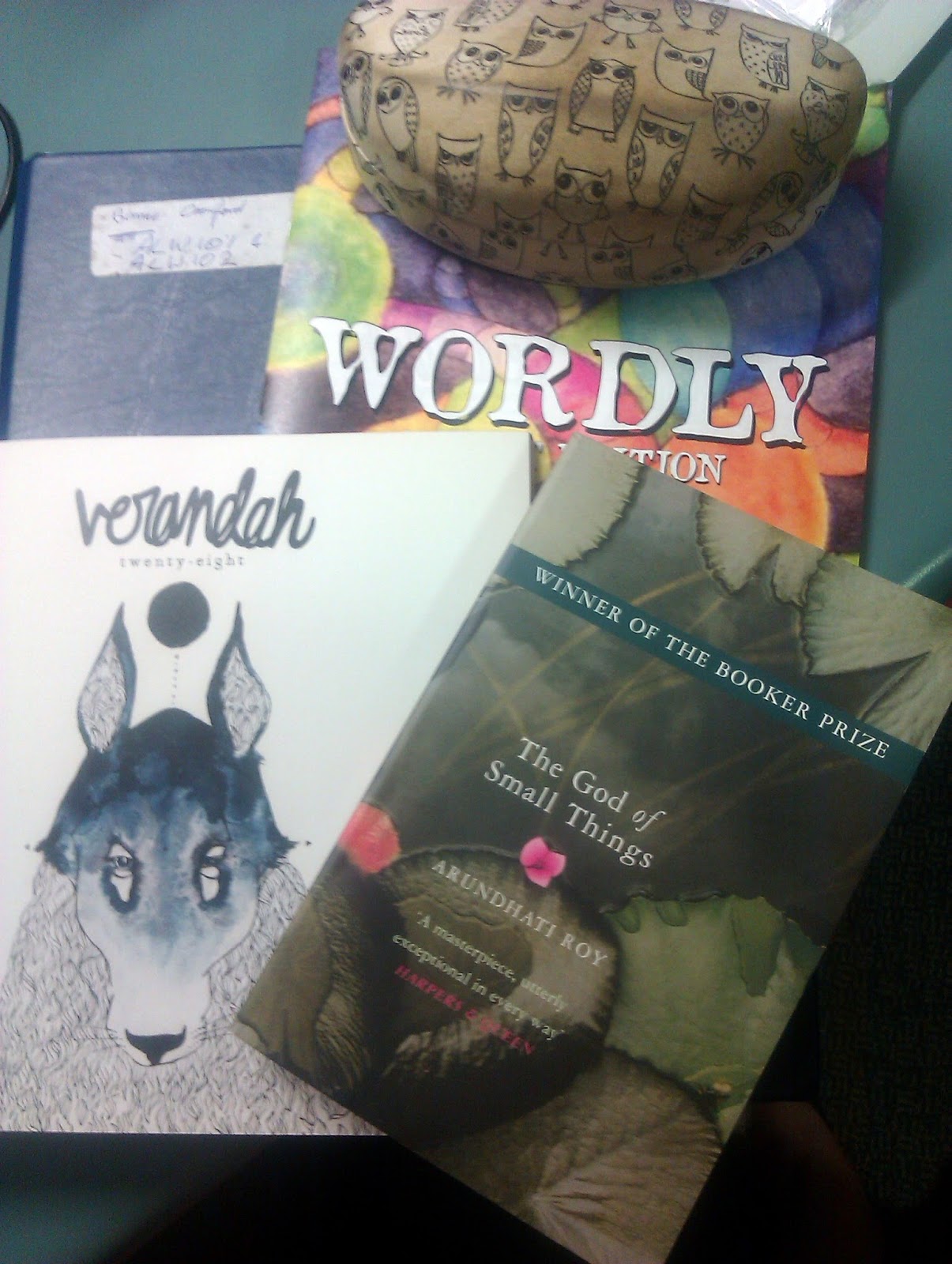
| My Writing Craft/Writing Spaces folder, under the Wordly: August Edition, my glasses case, my new copy of Verandah twenty-eight, and The God of Small Things by Arundhati Roy. |
- Melbourne Writers Festival event: the launch of Verandah twenty-eight, the 28th edition of the annual Verandah literary journal published by Deakin University.
- A review of Verandah twenty-eight
- Writing Spaces: The Novel (although it falls under the 'Prose Fiction' category, it was given a lecture of its own)
- Literature and post-colonialism
- A review of The God of Small Things by Arundhati Roy
- Writing Spaces: The Exegesis and Theory
- The 'ressie writers group' I have officially started
- How I felt about the first creative assignment I had to hand in for Writing Spaces (including workshopping it a few weeks ago), and how I'm feeling about the second assignment.
- The Deakin Writers Club Wordly: Space edition
The writing space of Prose Fiction includes the novel, novella, short story, and flash fiction, but the first lecture was mostly focused on the shorter forms and not the novel. These shorter types of Prose Fiction can generally afford to be more radical and experimental than the novel.
The short story is an older form of story-telling than the novel, but it has received some heavy criticism, such as being simply a starting-point for writers who then go on to write novels. I disagree with that, as there are short stories that are capable of outshining some novels and some authors who write predominantly in the form of short stories, if not completely. I love writing short stories! Another criticism short stories have received is that of being outshone by the even shorter form of flash fiction. There also seems to be a ratio problem between people who want to write short stories and people who want to read them. It seems more readers are inclined towards novels despite the numerous writers who adopt the shorter forms, though I personally love both forms.
But what makes a short story? Or rather, what does a short story make? A short story makes a deep and thoughtful comment on the culture and our experiences of it. Not only this, but it also makes our experience of the culture strange to us and then re-explains it. At least, this is how the lecturer explained it and I think it's a brilliant answer.
I guess what makes a short story does also need to be considered. While short stories generally follow the same rules as a novel, there is more strictness in some areas and of course, a smaller word count. Short stories begin quickly, in the midst of an experience, and use only a limited number of characters and scenes. Our lecturer advised us to start as close to the end as possible and deal with only one major issue or problem, giving just enough necessary detail and allow for suggestive details too.
This all made me stop and think about the short stories that I've read and how much I love both reading and writing short stories and flash fiction. My personal favourites are Love and Honour and Pity and Pride and Compassion and Sacrifice from the collection The Boat by Nam Le, and of course Super-Frog Saves Tokyo from the collection after the quake by Haruki Murakami... actually, make that all of the short stories in the Murakami collection, they were especially amazing.
What do you think of short prose fiction? What are your favourite examples of it? Do you prefer to read or write it?
- Bonnee.


 Posts

