As I mentioned in the previous post, none of my lectures have covered poetry per-say, but a couple of weeks ago we looked very briefly at poetics before spending the majority of the lesson looking at An Oresteia, which was one of the texts we could respond to in our final assignment. I didn't like that we spent a whole lecture looking at it seeing as certainly not everyone was going to respond to it.
Poetics refers to the different ways of reading a text and the effect it then has on a reader through the way certain elements of the text come together. Different ways of reading a text, especially something like poetry, are as representationalism, symbolism, and by interpretation not only of the facts and certainties that are communicated, but also of the mysteries and questions that are left unanswered.
As writers, it might be useful for us to ask ourselves how we look at our own writing?
Another question to ask ourselves is a question my lecturer from last trimester asked in our final lesson and a question a guest speaker last week asked us: Why are you here? For me and the people being asked directly, they meant this question with regards to us being in a creative writing course, but the question broadens itself to why do we write, which is something I have asked here before.
Our guest speaker last week went on to talk about how working in the writing industry usually requires a level of flexibility, especially when working in small press. I write because I love writing and I want to communicate messages - truths, ideals, opinions, beliefs - with an audience. Whether I can make a living through doing so or not aside, that is what I want to do. However, to be able to support myself, I'll hopefully gain a role as a professional proofreader, editor, maybe even one day an agent.
How do you look at your own writing? Why do you write?
- Bonnee.
Showing posts with label Writing Spaces. Show all posts
Showing posts with label Writing Spaces. Show all posts
Tuesday, October 8, 2013

Thursday, October 3, 2013
Writing Spaces: Sexualities
I was recently told off for not keeping my blog up to date with my classes by a classmate who has another lecture on at the same time and usually goes to the other one. I'm a little proud that some classmates are looking at my blog in order to study. Unfortunately, the reason I haven't been keeping up with the lectures here is that they haven't seemed to relate to Writing Spaces. Instead of the lecture on digital media, we had an industry guest speaker, which I shared a couple of posts ago. Then we were supposed to cover poetry in terms of sexualities one week and in terms of rhythm and economy the next week. Instead the lectures were about sexualities without placing it in a writing space, and then the next lecture was about one of the readings. I'm actually really upset that we didn't cover poetry.
I thought I'd share the sexualities lecture regardless of the fact that they didn't end up teaching us about a writing space. Good writing comes from being truthful, open-minded, well-informed, daring, and inventive. One of the many beauties of our art form is that it can be used as a freedom practice; no one can tell us what to write and what not to write. The world is slowly starting to adopt a similar view on love and sexuality. I make the distinction between love and sexuality here because while heterosexuality was already widely accepted by society, there are still couplings within it - between different cultures, between different social classes - that have been frowned upon at least in the past if not today.
The fun that comes with writing about love, though not necessarily in the form of romance genre writing, is that it is something that is often unstable and unpredictable. For example, I'm slowly reading the book The God of Small Things by Arundhati Roy. I wouldn't consider the book a romance by any means, but the portrayal of love, especially when it is forbidden, reoccurs throughout the text.
On a similar note, I've just gotten ready for a ressie block-party. The theme is gender bender. I'm feeling pretty manly at the moment. So I'll end the post here and join my housemates in partying now. Have a great night!
Have you explored love and sexualities in your writing? Can you think of any books you've read where this has happened?
- Bonnee.
I thought I'd share the sexualities lecture regardless of the fact that they didn't end up teaching us about a writing space. Good writing comes from being truthful, open-minded, well-informed, daring, and inventive. One of the many beauties of our art form is that it can be used as a freedom practice; no one can tell us what to write and what not to write. The world is slowly starting to adopt a similar view on love and sexuality. I make the distinction between love and sexuality here because while heterosexuality was already widely accepted by society, there are still couplings within it - between different cultures, between different social classes - that have been frowned upon at least in the past if not today.
The fun that comes with writing about love, though not necessarily in the form of romance genre writing, is that it is something that is often unstable and unpredictable. For example, I'm slowly reading the book The God of Small Things by Arundhati Roy. I wouldn't consider the book a romance by any means, but the portrayal of love, especially when it is forbidden, reoccurs throughout the text.
They all crossed into forbidden territory. They all tampered with the laws that lay down who should be loved, and how. And how much.Feminism also ties in with the literary discussion on sexualities. Not only is it an issue that can be incorporated into stories, but people like Jane Austen and the Bronte sisters became leaders of feminism through their writing when it was still considered a man's practice.
On a similar note, I've just gotten ready for a ressie block-party. The theme is gender bender. I'm feeling pretty manly at the moment. So I'll end the post here and join my housemates in partying now. Have a great night!
Have you explored love and sexualities in your writing? Can you think of any books you've read where this has happened?
- Bonnee.
Sunday, September 22, 2013
Writing Spaces: Getting Published
Of course the week they decide to do something that wasn't on the programme was the week that I couldn't make it to class on account of a job interview. Oh yeah, I got a job interview for a job in the library next year. I also got the job. Fingers crossed that'll go well. But yeah, the job interview made me miss the lecture, and then the lecture wasn't about what it was supposed to be about. It was supposed to be about digital media, but instead we had a guest speaker from the Australian Society of Authors talking about some of the inner workings of the publishing industry.
What I didn't realise was that lecture recordings this trimester, or at least for this particular lecture, was audio only due to copyright issues. Which royally sucks, because half of the lecture was the guest speaker referring to charts and lists and whatnot, which is a little useless when you're only listening to audio. So although I listened to the lecture, a lot was going way over my head, much to my dismay.
Nevertheless, I am here to share as much as I can of things I have learned.
The first thing the lecturer stressed that we needed to be aware of as writers is what's going on with reading and books. That is, who is buying and in what mediums? Who is reading and what are they reading? Who is not reading and what is not being read? There are trends and fads in the literary world all the time and it is our job as writers to keep up with them, make them, and break them.
We need to know what different mediums exist: not just books, but also ebooks, magazines, and journals. There is a whole digital and online market on top of the hard-copy books and physical bookstores. Writers need to determine which mediums suit their creations best and which mediums suit them best. This is also where the choice between traditional publishing and self publishing comes in.
Who are the players in the writing and publishing business? Obviously, there's us, the writers. Then you've also got the publishers, the agents, the editors, the booksellers, and everyone else who lies somewhere in between. In Australia, we've also got the Australian Society of Authors, who help negotiate better terms and conditions for us and help deal with government issues around us. I'm going to guess there are probably similar organisations in other countries.
Writers need business skills, or somebody who does to help us. Some of these skills include knowing how to read the book market, understanding your market and yourself, knowing why you're writing and where your writing fits into your market, and where you are getting your income from.
The note about income is a relevant point to linger on. It is hard to make a living just of writing books and you're pretty amazing if you manage it, but the bottom line is that not everybody can do it, especially not right from the word go. From your writing, you'll get income from advances and royalties, and possibly from grants, fellowships, Public Lending Rights, Educational Lending Rights, Digital Lending Rights, copyright agencies, teaching, and public speaking. Depending on how well your writing is received by readers, this may or may not be enough, and it's not uncommon for writers to have other jobs and means of income, whether it still be publishing-industry related or a job from a completely different field.
What else do we need to do? We need to gather info. This can be done by subscribing to journals, reading in the library, researching online for example on the websites of organisations like ASA, and going to writers festivals and conferences. It is important to do our industry research. Find out who is publishing your genre, who is taking unsolicited manuscripts, what their editorial guidelines are, and remember to only send what they've asked you for. Know who your competition is and what makes you different from them and learn how to talk to people. Gather your resources, know how to talk to agents, publishers, editors, maybe even accountants and lawyers. Get serious about your professional development. Know what your rights are. Overall, just make sure you how know to make the most of being a part of the writing and publishing industry.
As for the publishers, they are looking for new material and new voices. It's a risky job for them, even when they're dealing with pre-established authors, but once they've found someone they think has potential they will invest in them; understand them, their writing, their market, and how they perform in public. A publishers job is to form a list that represents what their house stands for, and this is why it is important that writers know what publishers are looking for, because at the end of the day they will make a decision based on commercial value and potential.
I really wish I'd been able to see some of the charts and lists the guest speaker put on on the screens. It sounded like there was some interesting information and statistics there, but I think this post is long enough now, as much as I would have loved to share more with you. Sorry if a lot of this read like dot-points.
Have you got any tips and tricks for getting published, or some insight on how the publishing industry works?
- Bonnee.
We need to know what different mediums exist: not just books, but also ebooks, magazines, and journals. There is a whole digital and online market on top of the hard-copy books and physical bookstores. Writers need to determine which mediums suit their creations best and which mediums suit them best. This is also where the choice between traditional publishing and self publishing comes in.
Who are the players in the writing and publishing business? Obviously, there's us, the writers. Then you've also got the publishers, the agents, the editors, the booksellers, and everyone else who lies somewhere in between. In Australia, we've also got the Australian Society of Authors, who help negotiate better terms and conditions for us and help deal with government issues around us. I'm going to guess there are probably similar organisations in other countries.
Writers need business skills, or somebody who does to help us. Some of these skills include knowing how to read the book market, understanding your market and yourself, knowing why you're writing and where your writing fits into your market, and where you are getting your income from.
The note about income is a relevant point to linger on. It is hard to make a living just of writing books and you're pretty amazing if you manage it, but the bottom line is that not everybody can do it, especially not right from the word go. From your writing, you'll get income from advances and royalties, and possibly from grants, fellowships, Public Lending Rights, Educational Lending Rights, Digital Lending Rights, copyright agencies, teaching, and public speaking. Depending on how well your writing is received by readers, this may or may not be enough, and it's not uncommon for writers to have other jobs and means of income, whether it still be publishing-industry related or a job from a completely different field.
What else do we need to do? We need to gather info. This can be done by subscribing to journals, reading in the library, researching online for example on the websites of organisations like ASA, and going to writers festivals and conferences. It is important to do our industry research. Find out who is publishing your genre, who is taking unsolicited manuscripts, what their editorial guidelines are, and remember to only send what they've asked you for. Know who your competition is and what makes you different from them and learn how to talk to people. Gather your resources, know how to talk to agents, publishers, editors, maybe even accountants and lawyers. Get serious about your professional development. Know what your rights are. Overall, just make sure you how know to make the most of being a part of the writing and publishing industry.
As for the publishers, they are looking for new material and new voices. It's a risky job for them, even when they're dealing with pre-established authors, but once they've found someone they think has potential they will invest in them; understand them, their writing, their market, and how they perform in public. A publishers job is to form a list that represents what their house stands for, and this is why it is important that writers know what publishers are looking for, because at the end of the day they will make a decision based on commercial value and potential.
I really wish I'd been able to see some of the charts and lists the guest speaker put on on the screens. It sounded like there was some interesting information and statistics there, but I think this post is long enough now, as much as I would have loved to share more with you. Sorry if a lot of this read like dot-points.
Have you got any tips and tricks for getting published, or some insight on how the publishing industry works?
- Bonnee.
Monday, September 16, 2013
Writing Spaces: Exegesis and Theory
I want to first of all apologise to everyone for the sudden inundation of new posts from me this past week or so. Not only have I recently had a lot to tell you about, but I also fell behind in making the re-caps of the Writing Spaces lectures and I really wanted to catch up on them.
As a part of our next assignment, Writing Spaces students have been asked to hand in a creative piece (both a first draft with workshopping notes and a final draft) and an exegesis. So our lecturer thankfully decided that he should probably explain to us exactly what an exegesis is, especially in relation to writing and what we've been asked to do for our assignment.
Exegeses are self-analytic critiques and reviews of the process of how something, in this case our creative writing piece, was produced, or an explanatory note of discourse. They can be done in the form of a video or in writing. An exegesis comments on and/or seeks to explain one's own creative work. They can often be found in books in the form of a preface, introduction, apology, foreword, afterword, author's note, or footnote.
This is the example video on YouTube that we were shown in the lecture. (Had trouble embedding the video to the post for some reason... sorry!)
An exegesis can be used to explain the writing, the creative processes, and the methods used. It can also be used as a way of providing guidelines for readers by giving them relevant information about the research that was done for the story, relevant information about yourself as the author, creative strategies, and as a chance to discuss issues around the work. This is where an author can explain their motives and reasons for writing, their doubts, successes, and difficulties, and general advice on how it would be best for the reader to approach the work. Basically, an exegesis is written in the hope of providing a better or more informed experience for the reader by focusing on what you as the author think is especially important for the understand of your work (e.g. your creative process, your diagnosis of your own achievements, or your understanding of your own motivation).
A good exegesis contains astute critical thinking, and an understanding of: the context of your creative piece; techniques/strategies; your field and others in your field; decisions you made as you created; and your work overall. It could also contain perceptive research and investigation of the issues that were significant to your piece and into the workings of your own mind, emotions, practices, and methods.
An exegesis is theoretical in the sense that it creates insights that can be used to think about other works as well as the one discussed by its creator. I say creator here because exegesis and theory is not limited to the art of writing. It is theoretical because while it is more than a hypothesis of how something was made, it doesn't go out of its way to state or explain the obvious.
So this is going to be an interesting assignment, seeing as my creative piece is a creative non-fiction recount of writing my W.I.P KATHERINE and is in a way an exegesis itself, and I have to write an exegesis on that... hmm.
Have you ever written an exegesis?
- Bonnee.
As a part of our next assignment, Writing Spaces students have been asked to hand in a creative piece (both a first draft with workshopping notes and a final draft) and an exegesis. So our lecturer thankfully decided that he should probably explain to us exactly what an exegesis is, especially in relation to writing and what we've been asked to do for our assignment.
Exegeses are self-analytic critiques and reviews of the process of how something, in this case our creative writing piece, was produced, or an explanatory note of discourse. They can be done in the form of a video or in writing. An exegesis comments on and/or seeks to explain one's own creative work. They can often be found in books in the form of a preface, introduction, apology, foreword, afterword, author's note, or footnote.
This is the example video on YouTube that we were shown in the lecture. (Had trouble embedding the video to the post for some reason... sorry!)
An exegesis can be used to explain the writing, the creative processes, and the methods used. It can also be used as a way of providing guidelines for readers by giving them relevant information about the research that was done for the story, relevant information about yourself as the author, creative strategies, and as a chance to discuss issues around the work. This is where an author can explain their motives and reasons for writing, their doubts, successes, and difficulties, and general advice on how it would be best for the reader to approach the work. Basically, an exegesis is written in the hope of providing a better or more informed experience for the reader by focusing on what you as the author think is especially important for the understand of your work (e.g. your creative process, your diagnosis of your own achievements, or your understanding of your own motivation).
A good exegesis contains astute critical thinking, and an understanding of: the context of your creative piece; techniques/strategies; your field and others in your field; decisions you made as you created; and your work overall. It could also contain perceptive research and investigation of the issues that were significant to your piece and into the workings of your own mind, emotions, practices, and methods.
An exegesis is theoretical in the sense that it creates insights that can be used to think about other works as well as the one discussed by its creator. I say creator here because exegesis and theory is not limited to the art of writing. It is theoretical because while it is more than a hypothesis of how something was made, it doesn't go out of its way to state or explain the obvious.
So this is going to be an interesting assignment, seeing as my creative piece is a creative non-fiction recount of writing my W.I.P KATHERINE and is in a way an exegesis itself, and I have to write an exegesis on that... hmm.
Have you ever written an exegesis?
- Bonnee.
Sunday, September 8, 2013
Writing Spaces: The Novel

In the lecture, we talked about some of the qualities of a novel. It's a form of long prose fiction which is capable of exploring every type of plot, in many different styles and genres. It has the capacity to cover every imaginable subject matter from all points of view. This writing space appeared with the print revolution and has developed since then into the most diverse and commercially used forms of literature. Today, a novel has the freedom to explore multiple conflicts and complex issues and themes in depth, which is something that cannot be done as successfully within the constrains of shorter prose.
The novel that we studied for this particular part of the unit was The God of Small Things by Arundhati Roy. I haven't finished it yet, but none of my assignments are going to be based on it so that's okay. I'm determined to finish it though, as I firmly believe that it is one of the best books I have ever read. I'm only a quarter of the way through and so I won't say it's because of the plot or the characters, though so far I love them too. What I love most about this book is Roy's ability to surprise me over and over again on every page by the way she phrases things. There are so many moments, moments I wouldn't have even considered, that could have been written in cliches, but the descriptions in this book are so incredibly unique that it makes me want to keep reading and never stop. I can't wait to finish reading it.
Writing a good novel takes a lot of hard work. There's finding and developing a substantial idea for the novel, and then there's putting in the hard yards to writing out that first draft. Then there's looking over your first draft, seeing it riddled with cliches and unnecessary dialogue, among other things, and having to redraft it. And redraft it again. And again. Until you are satisfied that it is good enough to start showing people. I mean people who matter, like agents. Especially agents. If you're lucky enough to get an agent, then there's all of the redrafting and editing they'll make you do, and all the editing and redrafting you'll have to do to please the publisher if you make it that far.
Basically, editing and redrafting is a lot harder and more time consuming when you've got a chapter length novel that's tens of thousands or hundreds of thousands of words long, than when you're doing the same thing for a short story. Novels require a long-term commitment. Maybe this is a big part of why some people consider short stories the inferior 'easy' way into publishing. (I am not one of these people. I love a good short story as much as I love novels. This is just food for thought and whatnot, so no hating.)
What are some of the best novels you have ever read and why?
- Bonnee.
Tuesday, September 3, 2013
Writing Spaces: Prose Fiction
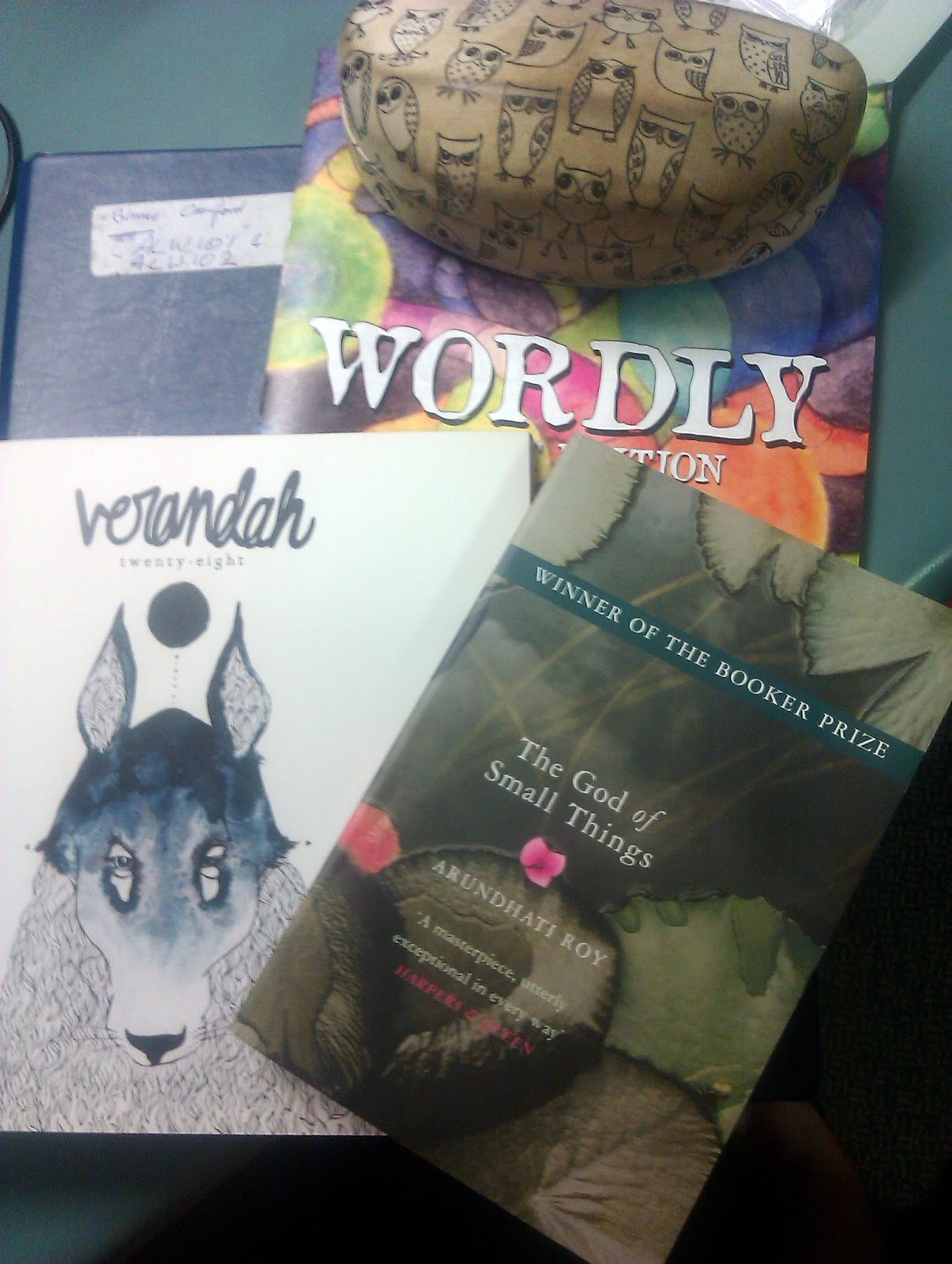 |
| My Writing Craft/Writing Spaces folder, under the Wordly: August Edition, my glasses case, my new copy of Verandah twenty-eight, and The God of Small Things by Arundhati Roy. |
- Melbourne Writers Festival event: the launch of Verandah twenty-eight, the 28th edition of the annual Verandah literary journal published by Deakin University.
- A review of Verandah twenty-eight
- Writing Spaces: The Novel (although it falls under the 'Prose Fiction' category, it was given a lecture of its own)
- Literature and post-colonialism
- A review of The God of Small Things by Arundhati Roy
- Writing Spaces: The Exegesis and Theory
- The 'ressie writers group' I have officially started
- How I felt about the first creative assignment I had to hand in for Writing Spaces (including workshopping it a few weeks ago), and how I'm feeling about the second assignment.
- The Deakin Writers Club Wordly: Space edition
The writing space of Prose Fiction includes the novel, novella, short story, and flash fiction, but the first lecture was mostly focused on the shorter forms and not the novel. These shorter types of Prose Fiction can generally afford to be more radical and experimental than the novel.
The short story is an older form of story-telling than the novel, but it has received some heavy criticism, such as being simply a starting-point for writers who then go on to write novels. I disagree with that, as there are short stories that are capable of outshining some novels and some authors who write predominantly in the form of short stories, if not completely. I love writing short stories! Another criticism short stories have received is that of being outshone by the even shorter form of flash fiction. There also seems to be a ratio problem between people who want to write short stories and people who want to read them. It seems more readers are inclined towards novels despite the numerous writers who adopt the shorter forms, though I personally love both forms.
But what makes a short story? Or rather, what does a short story make? A short story makes a deep and thoughtful comment on the culture and our experiences of it. Not only this, but it also makes our experience of the culture strange to us and then re-explains it. At least, this is how the lecturer explained it and I think it's a brilliant answer.
I guess what makes a short story does also need to be considered. While short stories generally follow the same rules as a novel, there is more strictness in some areas and of course, a smaller word count. Short stories begin quickly, in the midst of an experience, and use only a limited number of characters and scenes. Our lecturer advised us to start as close to the end as possible and deal with only one major issue or problem, giving just enough necessary detail and allow for suggestive details too.
This all made me stop and think about the short stories that I've read and how much I love both reading and writing short stories and flash fiction. My personal favourites are Love and Honour and Pity and Pride and Compassion and Sacrifice from the collection The Boat by Nam Le, and of course Super-Frog Saves Tokyo from the collection after the quake by Haruki Murakami... actually, make that all of the short stories in the Murakami collection, they were especially amazing.
What do you think of short prose fiction? What are your favourite examples of it? Do you prefer to read or write it?
- Bonnee.
Monday, August 5, 2013
Writing Spaces: Creative Non-Fiction

The past two weeks in Writing Spaces has covered creative non-fiction, and we had a couple of really good lectures. The main reading for this writing 'space' was the Calibre Prize essay 'What're yer lookin' at yer fuckin' dog?' by Kevin Brophy, which recounts Kevin Brophy's experience with some bad neighbours and how he relates himself and his situation to the philosophy of violence he'd read in some essays written by Salvoj Žižek. I really enjoyed reading this piece.
Last week focused predominantly on the question 'what is truth?' Our lecturer last week gave us some ways to define and consider truth in writing, such as how the writer's opinion represents or re-presents the facts and how the writer gives the truth a particular perspective. The writer also has to fragment; this means choosing what parts of the story to tell, what not to tell, and what irrelevant and boring details and conversions to exclude. The author's voice portrays the truth in a particular way, according to how the author him or herself wants to portray it.
Keeping in mind that it's creative non-fiction, sometimes the story being told is a metaphor for something else and we are able to find subtexts that may not have been considered in reality when events were taking place. Perhaps the piece is a metaphor that reveals something about people, society, ourselves, or anything really. The resonance of the piece - the parts that stays with you the longest, the parts you can relate to, the parts that make you recall something - is important, especially in the case of creative non-fiction, for the reader to be able to reflect both on what they've read and what they've experienced personally, in reality.
But when reading creative non-fiction and when writing it, how do we know what the truth is and how are we sure that we know it? I think it's a matter of allowing yourself, especially as the writer, to admit that sometimes memories are not always accurate. Kevin Brophy does this in 'What're yer lookin' at yer fuckin' dog?' when his character openly admits that perhaps he is being unfair by recounting only the worst of the bad neighbours' behaviour. This is acceptable, because the writing 'space' is creative non-fiction, not a journalistic article of the events that occurred. Similarly, when I studied the creative non-fiction novel 'In Cold Blood' by Truman Capote in literature last year, it was evident from very early on that Capote portrays the murderer Perry as sort of a good guy, at least to the point where the reader feels sorry for him and forgiving towards him, though not so for his accomplice who is portrayed as a real arsehole.
Today, we took a closer took at the Brophy reading and highlighted some other elements of creative non-fiction that are used: the journalistic/academic stand of creative non-fiction writing; an emphasis on accuracy and facts; an accurate transcription of direct quotations; attention to issues of truth, reality and fictionality; a creative and self-conscious use of language; use of ideas that branched off from the main narrative; the persona of the writer as a character; and the writer's vulnerability. Of course, there are many more elements of creative non-fiction that might not have been used, and the ones that were used don't have to be used to make a creative non-fiction piece. This is to say that every piece will need to follow a different set of rules to come across at its strongest.
Overall, I think we learned a lot more in the past two weeks on creative non-fiction than we did in the first two weeks with script writing. The Kevin Brophy essay is an amazing read, and I've chosen to write in response to it for the first assignment, although I'll still try and read the other texts we have the option to respond to.
Have you read or written any creative non-fiction? What did you think?
- Bonnee.
Monday, July 29, 2013
Nobody Likes Mondays
Last trimester, Monday was my favourite day of the week because both the lecture and my tutorial for Writing Craft were that morning. Writing Craft has been replaced with Writing Spaces this trimester and while both of my classes are still on the Monday, Monday has stopped being my favourite day of the week. Why? I asked myself this too, but the answer is quite simple and I already knew it.
Writing Spaces is supposed to be about learning to write in the different 'spaces' or 'formats'. For example, the unit is covering how to write in script, creative non-fiction, poetry, prose, etc. We've had a different person take the lecture every week. The first guy was okay, but the lesson was boring and irrelevant because it was just introductory 'making sure everybody knows how to use the unit guide' stuff. I think he'd have the potential to be engaging if he'd actually taught us something for the subject. The person who ran the second lecture, last week, and who also runs my tutorial every week... is so boring that it's hard not to zone out, and she doesn't seem to know what she's doing: rather than teaching us about the elements of writing in the spaces that we're trying to learn, she spent both the lecture she hosted and the tutorials only talking about the writing craft elements within the readings. She's frustrating, and I could say much more, but I won't. Oh my she is dreadful.
So thanks to the first week being all about introductory/housekeeping things, and the second week being completely run by the Dreadful One, I didn't learn anything particularly new about script writing. Those were the designated weeks for that 'space'. Basically, dialogue is of utmost importance (the irony of the Dreadful One's every second word being "um"...), directions are important though not AS important, and characters needs to be established and identifiable with certain settings, mannerisms (especially in the way they speak), and their personalities and ways of acting and reacting (which also needs to be communicated mostly through dialogue and some stage-direction). Now I'm sitting here wondering if the Dreadful One even taught us that or if I just assumed she taught us that because it's what I already knew about script-writing. My favourite part was getting to read some of Scott Silver's Untitled Detroit Project, which is based off the life of popular rapper Eminem and was the original script for the movie 8 Mile. I went through a bit of an Eminem phase a few years ago.
Writing Spaces is supposed to be about learning to write in the different 'spaces' or 'formats'. For example, the unit is covering how to write in script, creative non-fiction, poetry, prose, etc. We've had a different person take the lecture every week. The first guy was okay, but the lesson was boring and irrelevant because it was just introductory 'making sure everybody knows how to use the unit guide' stuff. I think he'd have the potential to be engaging if he'd actually taught us something for the subject. The person who ran the second lecture, last week, and who also runs my tutorial every week... is so boring that it's hard not to zone out, and she doesn't seem to know what she's doing: rather than teaching us about the elements of writing in the spaces that we're trying to learn, she spent both the lecture she hosted and the tutorials only talking about the writing craft elements within the readings. She's frustrating, and I could say much more, but I won't. Oh my she is dreadful.
So thanks to the first week being all about introductory/housekeeping things, and the second week being completely run by the Dreadful One, I didn't learn anything particularly new about script writing. Those were the designated weeks for that 'space'. Basically, dialogue is of utmost importance (the irony of the Dreadful One's every second word being "um"...), directions are important though not AS important, and characters needs to be established and identifiable with certain settings, mannerisms (especially in the way they speak), and their personalities and ways of acting and reacting (which also needs to be communicated mostly through dialogue and some stage-direction). Now I'm sitting here wondering if the Dreadful One even taught us that or if I just assumed she taught us that because it's what I already knew about script-writing. My favourite part was getting to read some of Scott Silver's Untitled Detroit Project, which is based off the life of popular rapper Eminem and was the original script for the movie 8 Mile. I went through a bit of an Eminem phase a few years ago.
When I'm Gone is my all-time favourite Eminem song. I tend to tear up listening to this...
Stan ft. Dido is my current little Eminem obsession.
Today, week 3, we moved on to creative non-fiction as a writing space. We had another different lecturer, who was engaging, informative and just generally awesome. Some friends and I were saying how much we enjoyed the lecture afterwards. Unfortunately, I still had the Dreadful One in my tutorial, which was unproductive as far as learning about creative non-fiction as a writing space went. Hopefully we'll learn a little more in next week's classes, or at least the lecture. I'll make a post about that when it's time.
In other news: I am still unemployed. Seriously, somebody hire me, I'm a poor uni student, have mercy! On a lighter note, I'M A STEP-AUNTIE to an adorable and chubby little boy. My dad and his dad have already decked him up with St Kilda (AFL team) teddy bears and Metallica beanies (alternating with the Winnie the Pooh beanie his mother has supplied) and I swear that if the 7am phone call I got from my dad had been for any other reason than to inform me that the baby had finally arrived, he would have be in big trouble for waking me up so early on a weekend. And last of all, a happy 3rd anniversary for tomorrow (30th) to my boyfriend, Aaron.
I'm sick, lacking sleep, and feeling that I've raged and rambled more than I'm comfortable with in a blog post, so I'll say goodnight here and be off to bed.
How has everybody else's writing and education and writing education been coming along? Who's an Eminem fan? Any special little announcements to make?
- Bonnee.
Subscribe to:
Posts (Atom)
Subscribe To


 Posts
All Comments
Posts
All Comments